The Main Points
This article looks at the industries that gain the most from a heavy-duty weighbridge and explains why. It also covers how a weighbridge works, what capacity and platform size to look at, how to choose a setup, and how to keep readings accurate.
How the Article Is Laid Out
Why Weighing Whole Vehicles Pays Off
Every truck that enters or leaves a plant carries money in the form of material, and the weight of that material usually decides the bill. If the weight is wrong by even a small share, the error repeats on every trip, and over a month it adds up to a large loss for either the buyer or the seller.
Bulk goods such as grain, sugar cane, aggregate and coal move by truck every day, so weighing errors can build up quickly. A heavy-duty weighbridge removes the guesswork by weighing the vehicle and its load together. It also helps with stock records, overloading checks and proof of weight in disputes, which is why the businesses below depend on it.
What a Weighbridge Is and How It Works
A weighbridge, also called a vehicle scale, is a large platform scale that weighs a whole vehicle with its contents. The vehicle drives onto the platform and stops, and the system shows the total weight. The same vehicle is weighed again after unloading, and the difference is the weight of the material.
Swisser Instruments describes its platform as a steel checkered top plate on a steel bottom frame, supported by load cells. A load cell is a sensor that turns the force of the weight into an electrical signal, and an indicator converts that signal into a reading in kilograms or tons. The load cells are listed as sealed to IP68, which means they are protected against dust and water, and the page lists an accuracy of better than 0.025% of full scale output.
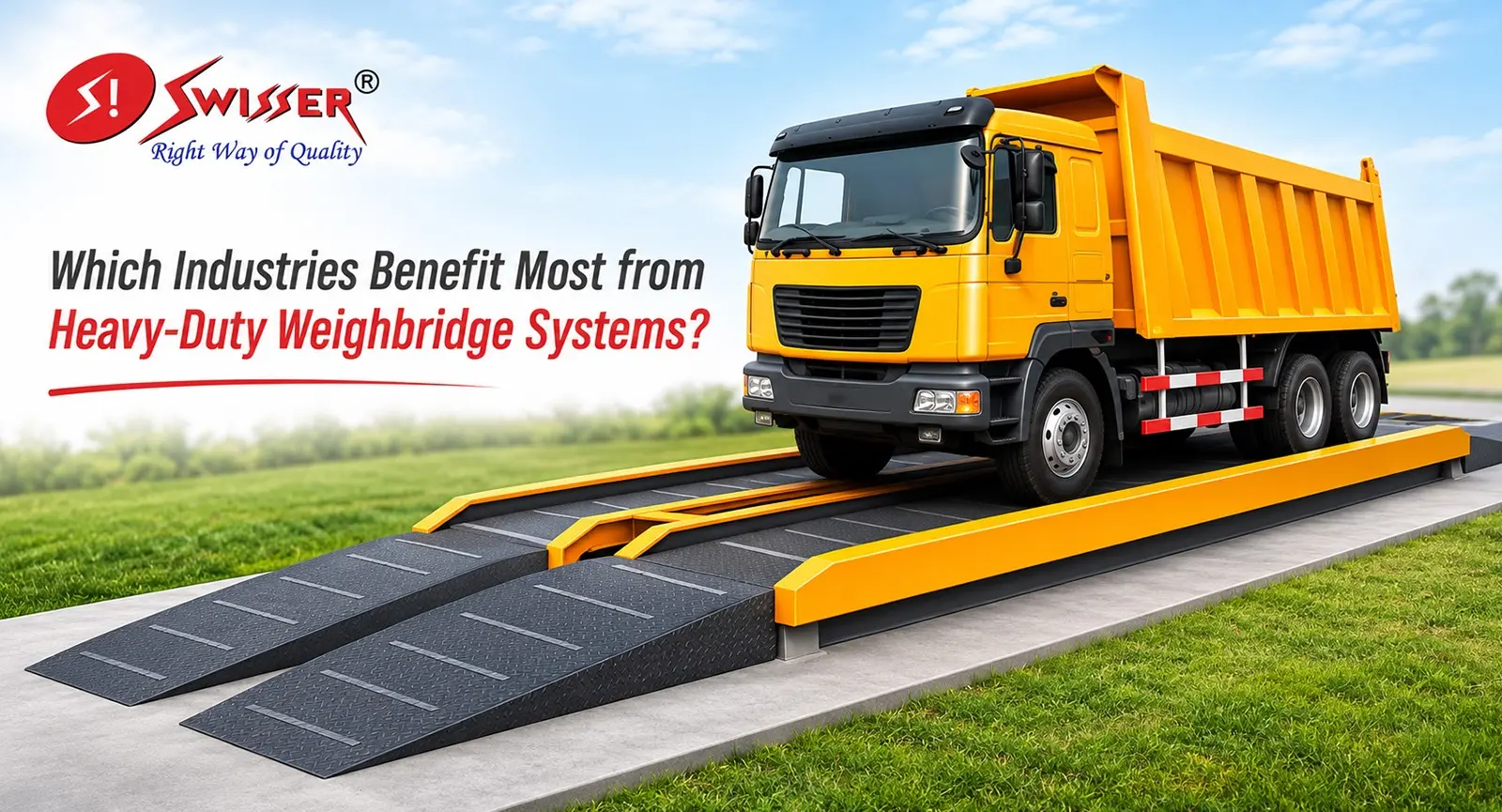
There are two main layouts. A pit-type weighbridge sits in a pit so the platform is level with the road, while a pitless weighbridge sits above ground and is reached by ramps.
Industries That Benefit Most
These are examples, and any business that buys, sells or dispatches heavy goods by truck can benefit.
Mining and quarries. Trucks leave these sites loaded with stone, sand, coal or ore that is sold by weight. A weighbridge gives a fair record for every load and helps control theft.
Construction and demolition. Sites move aggregate, cement, steel and debris all day. Weighing at the gate shows how much material arrives and leaves and keeps costs under control.
Agriculture and food processing. Sugar mills, grain traders and processors pay farmers by the weight of the produce they bring in. A weighbridge makes that payment transparent for both sides.
Steel and metal industries. Plants buy scrap and raw material and dispatch finished goods in heavy loads. Accurate weights protect margins on high-value material, and the page lists rolling materials among its applications.
Logistics and transport. Transporters use weighbridges to check loads before dispatch to avoid overloading and to settle freight on actual weight.
Waste management and landfills. Sites charge by weight, so each truck must be weighed when it comes in. The page lists rubbish for landfill sites as an application.
Forestry and timber. Logs are heavy, bulky and sold by weight, which makes truck weighing the simplest way to measure a load.
Defence and government sites. The page lists military use, where controlled gates and weight records are part of normal procedure.
What Heavy-Duty Capacity Means
Heavy-duty means the platform and load cells are built for full-size trucks that run all day in sun, rain and dust. Swisser lists capacities from 5 ton to 100 ton and says standard capacities run from 20,000 kg up to 100,000 kg.
The size of the platform rises with the capacity. A 4.5 by 2.5 metre platform is listed for 10 ton, while a 20 by 3 metre platform is listed for 80 or 100 ton. The number of load cells also rises, from four on smaller platforms to six and eight on longer ones, so that the weight is shared evenly. The graduation, which is the smallest weight step the display can show, is 2 kg on small models and up to 20 kg on the largest.
Other sizes and capacities can be made to suit individual needs and regulations.
Choosing the Right Setup
Capacity. Pick a capacity above your heaviest loaded vehicle, with a margin.
Platform length. The platform should be long enough to hold the whole vehicle, or the axle groups, as your weighing method requires.
Pit or pitless. A pit-type unit saves ramp space, while a pitless unit avoids digging. Check your site, drainage and budget.
Temporary or permanent site. The page lists a modular design that needs no foundation, can be installed in hours and can be moved to another site, which suits temporary sites such as construction and demolition.
Hazardous areas. The page states that explosion-proof load cells are also available.
Indicator and records. Ask whether the indicator can store weights, print slips or connect to a computer, because your accounts team will want records.
Keeping Readings Accurate
Calibrate regularly. Check the weighbridge with certified test weights at regular intervals, and record each check.
Keep the platform clean. Remove mud, stones and spilt material from the platform and from the gaps around it.
Check the load cells and cables. Look for damage, water entry and loose connections.
Keep the pit dry. If you have a pit, keep it drained and clear of debris.
Train the operators. Weigh vehicles only when they are stationary and fully on the platform.
Respect the limits. Do not drive loads above the rated capacity onto the platform.
Is Your Site Losing Money at the Gate?
If your weights are disputed, if trucks queue because weighing is slow, or if you suspect leakage of material, the weighbridge is the first place to look.
Swisser Instruments Pvt. Ltd. is based in Ahmedabad, Gujarat, and belongs to a group of companies founded in 1998. It offers weighbridges in customised options. Tell the team about your site, the largest vehicle you weigh, the material you handle and whether the site is temporary or permanent, and the team can suggest a suitable platform and capacity.