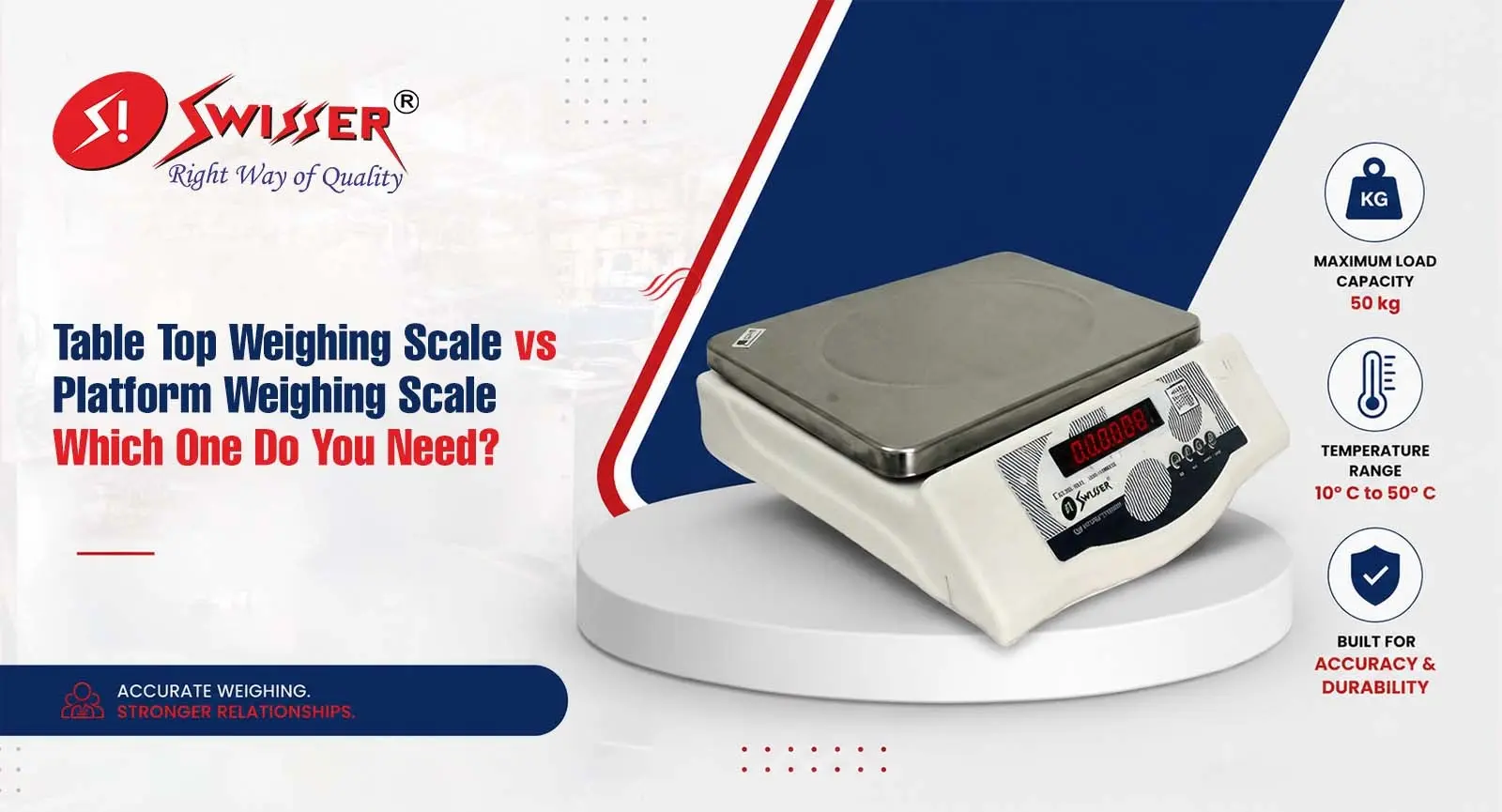
Quick Summary
A table top weighing scale is a compact scale for weighing small and medium items on a counter or workbench. A platform weighing scale has a larger, stronger base, stands on the floor and handles much heavier loads, such as cartons, drums and pallets. The right choice depends on the weight you handle, the size of the items, the accuracy you need and where you will use the scale. This guide explains the differences between both scales.
Table of Contents
What Is a Table Top Weighing Scale?
A table top weighing scale is a compact electronic weighing scale designed to sit on a table, counter or workbench. It has a small weighing pan, a digital display and a body that is easy to move around. You may also hear it called a counter scale, a bench scale or a digital weighing scale. It is a regular sight in shops, kitchens, labs and packing counters.
Inside the scale, a load cell senses the weight placed on the pan and turns it into an electronic signal. The display then shows the reading in grams or kilograms. These scales usually have a lower capacity, often up to a few tens of kilograms, but they give fine readability. That means they can show small differences in weight. This is why they are popular where accuracy matters more than load size.
What Is a Platform Weighing Scale?
A platform weighing scale has a larger, flat steel platform that stands on the floor. It weighs heavy loads, capacity usually starts from about 100 kg and can go up to several tonnes. It also uses load cells, but they are stronger and fitted under a thick base. The display unit, called the indicator, may be fixed on a post or placed on a wall or table, so the operator can read it comfortably. You will see these scales in warehouses, factories, loading docks, godowns and dispatch areas.
Table Top vs Platform Scale: Key Differences
Here is a simple comparison.
- Size: a table top scale is small and portable. A platform scale is large and usually stays in one place.
- Capacity: table top scales handle light loads. Platform scales handle medium to very heavy loads.
- Readability: table top scales can show smaller weight steps, so they are better for fine weighing.
- Platform area: platform scales have a bigger surface for large items, boxes and drums.
- Placement: table top scales sit on a counter. Platform scales stand on the floor.
- Build: platform scales have a heavier frame, made for rough handling.
- Mobility: table top scales are easy to move. Platform scales are heavy, though some have wheels.
- Cost: table top scales cost less in general. Platform scales cost more, as capacity and size increase.
Where Each Scale Is Used
Table top weighing scales are common in:
- Grocery, sweet and general retail shops.
- Restaurants, bakeries and commercial kitchens.
- Jewellery and small parts counters.
- Pharmacies and quality control tables.
- Packaging and parcel desks.
- Small workshops and laboratories.
Platform weighing scales are common in:
- Warehouses and godowns.
- Factories and production floors.
- Goods receiving and dispatch areas.
- Cold storage and food processing units.
- Scrap, agriculture and bulk material handling.
- Courier and logistics hubs.
How to Decide Which One You Need
Ask yourself these simple questions.
- What is the heaviest item I will weigh? If it is under about 30 kg, a table top scale is usually enough. If it is more, think about a platform scale.
- How big are the items? Large boxes, drums or sacks need a wider platform.
- How fine does the reading need to be? For small weights and exact measurement, choose a table top scale with fine readability.
- How often will I weigh? Heavy daily use needs a strong build.
- Will I move the scale? If yes, a lighter table top model is easier to carry.
- What is my working area like? Wet, dusty or rough areas need a robust, protected scale.
If you handle both small and heavy items, many businesses simply use two scales, one for each job.
Features to Look For Before Buying
Whichever type you choose, these points make a big difference.
- Capacity: choose one that is a little higher than your usual maximum load, but not far above it. A very large capacity may lower the accuracy for small weights.
- Readability (division): the smallest weight the scale can show. Match it to your needs.
- Accuracy class: a higher class means more reliable readings.
- Platform size and material: stainless steel is better for food and wet areas. Painted mild steel suits dry, heavy use.
- Display type: LCD or LED, with clear, bright digits.
- Power source: mains power with a rechargeable battery gives freedom to use the scale anywhere.
- Tare function: lets you remove the weight of a container.
- Extra functions: piece counting, price calculation and check weighing save time.
- Output options: USB or serial output helps if you need to connect to a printer or computer.
- Build and protection: a strong body and dust or splash resistance last longer.
- Legal approval: if you sell goods by weight, the scale usually needs approval and regular verification under your local legal metrology rules.
- Warranty and service: good after-sales support is important for any measuring device.
Common Buying Mistakes
- Choosing a table top scale for loads that are too heavy for it.
- Buying a very high capacity scale for tiny weights.
- Ignoring the size of the platform.
- Forgetting that trade use needs legal approval.
- Choosing only on price.
- Not thinking about the working environment.
- Skipping calibration after purchase.
Conclusion
A table top weighing scale is ideal for precise, small-load weighing at counters and workbenches. A platform scale suits heavy loads and rugged environments. Looking at your load size, accuracy needs, space and budget will give a clear answer. If you need reliable weighing scales in standard or customised capacities, Swisser Instruments is a leading manufacturer and supplier you can contact.
Frequently Asked Questions
What is a table top weighing scale used for?
It is used to weigh small and medium items on a counter or table, in shops, kitchens, labs, packing desks and workshops.
What is the difference between a table top scale and a platform scale?
A table top scale is small, portable and made for lighter loads with fine readings. A platform scale is larger and stronger, and it is made for heavy items and bulk goods.
What capacity do table top weighing scales come in?
Most range from a few kilograms up to around 30 kg or more. Capacity and readability vary by model, so check the specifications.
Which scale is more accurate, a table top or a platform scale?
For light weights, a table top scale usually gives finer readings. Accuracy depends more on the quality of the load cell, the scale’s rating and proper calibration than on the type alone.
What does readability mean on a weighing scale?
It is the smallest weight difference that the scale can show. A scale with a readability of 1 gram can show changes of 1 gram.
How often should a weighing scale be calibrated?
There is no single rule. Many users calibrate at regular intervals, such as once or twice a year, and also after moving or repairing the scale. Follow your local rules and the maker’s advice.
Can I use a digital weighing scale for trade?
Only if it is approved for trade and verified as required by the legal metrology rules in your area. Check with the authority before use.