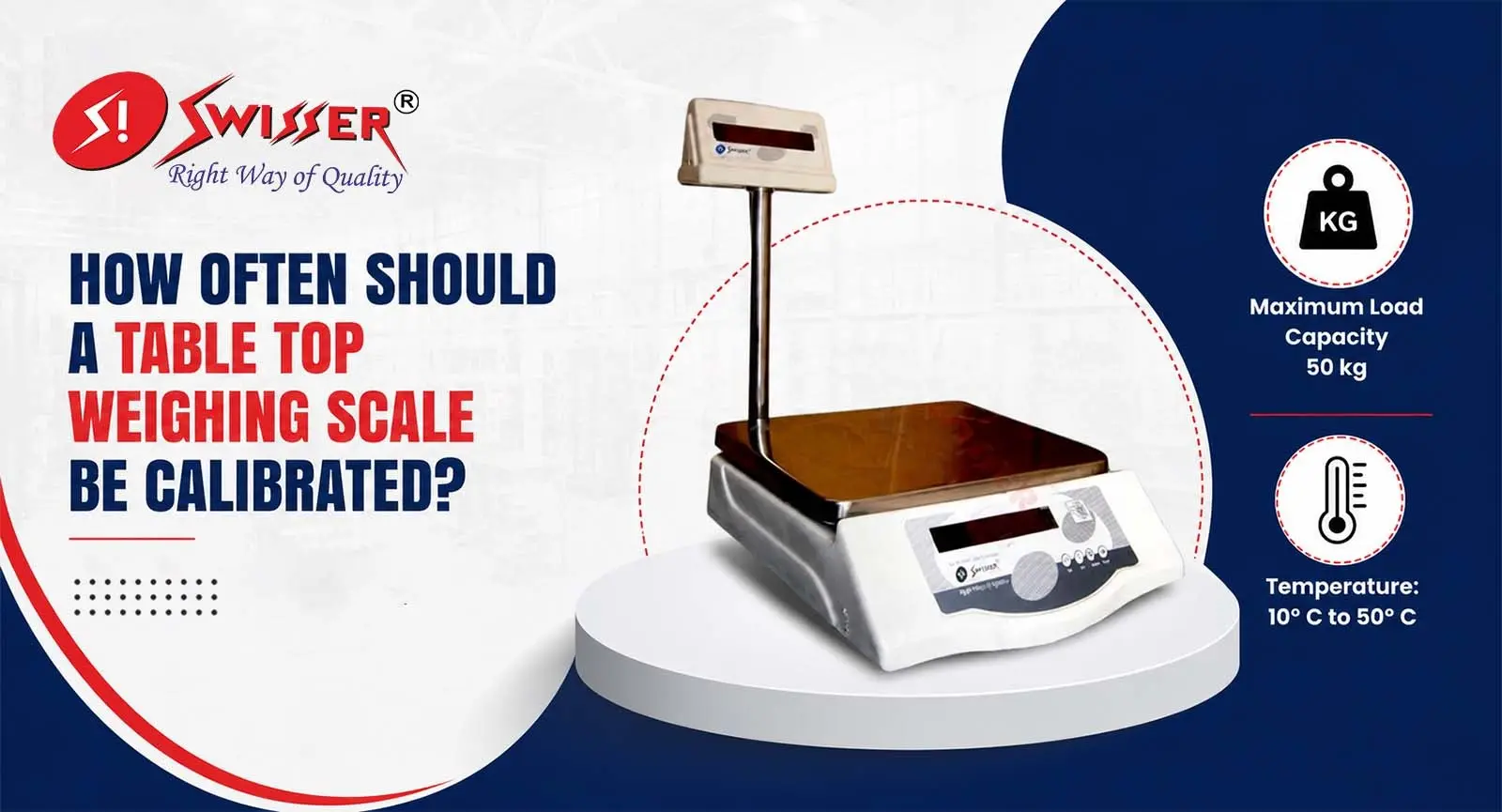
Quick Summary: For general use, calibrating a table top weighing scale once a year is usually enough. But if you are in food, pharma, or logistics, every three to six months makes more sense. Regular calibration keeps readings accurate, keeps you compliant, and saves you from the kind of measurement errors that quietly cost businesses money.
Table of Contents
- What Is Calibration and Why Does It Matter?
- How Often Should You Calibrate a Table Top Weighing Scale?
- Factors That Affect Calibration Frequency
- Signs Your Table Top Weighing Scale Needs Calibration Now
- What Happens During a Calibration Process?
- Who Should Calibrate Your Weighing Scale?
- Tips to Keep Your Scale Accurate Between Calibrations
- FAQs
What Is Calibration and Why Does It Matter?
A table top weighing scale is only useful when it gives you an accurate reading. Over time, even the best scales drift away from their true values. This drift can happen slowly and go unnoticed for weeks, but the impact on your business can be significant — wrong measurements in production, overcharging or undercharging customers, or failing a compliance audit.Calibration is the process of adjusting a weighing scale so its readings match a known, traceable standard. Think of it as resetting the scale back to its accurate baseline. For any business that depends on precise measurements — whether that is a pharmaceutical company, a food processor, a jewellery workshop, or a logistics operation — calibration is not optional. It is part of running things correctly.How Often Should You Calibrate a Table Top Weighing Scale?
There is no one-size-fits-all answer, but here is a straightforward guide based on how the scale is being used:- General use (retail, light workshop, office): Once a year is usually fine
- Moderate use (small manufacturing, packaging lines): Every six months
- Heavy use (pharma, food processing, labs, logistics): Every three months or more frequently
- After repair, relocation, or any electrical fault: Calibrate immediately, before putting the scale back into service
Factors That Affect Calibration Frequency
Different environments and usage patterns change how quickly a table top weighing scale loses its accuracy. Here are the main factors to consider:Usage Volume A scale that weighs hundreds of batches per shift experiences more mechanical stress than one used a few times a day. Higher usage means faster wear on internal components, which can affect accuracy more quickly.Environmental Conditions Heat, humidity, dust, and vibration all interfere with scale performance. A scale sitting near an oven, a production machine, or an air conditioning unit will drift more quickly than one kept in a stable, controlled space.Type of Loads Being Weighed Repeatedly placing loads at the same corner of the platform, or regularly pushing the scale to near its maximum capacity, puts uneven stress on the load cell. This speeds up drift and makes more frequent calibration necessary.Age of the Scale Older scales tend to drift more readily than newer ones. If your scale is five or more years old, it is worth increasing calibration frequency regardless of usage.Industry Requirements Pharmaceutical companies, food manufacturers, and legal-for-trade businesses often have regulatory requirements that override general guidelines. Always check what your specific industry demands.Signs Your Table Top Weighing Scale Needs Calibration Now
Do not wait for your scheduled calibration if you notice any of these signs:- The scale shows different readings for the same object placed twice in the same position
- The empty scale does not return to exactly zero after a load is removed
- Known reference weights are reading differently than expected
- The scale has been moved, dropped, or subjected to a shock
- You recently had the scale repaired or replaced any internal components
- Readings have been creeping up or down gradually over several weeks
- The display is unstable or fluctuates without any load on the platform
What Happens During a Calibration Process?
Calibration does not have to be complicated, but it should always be done carefully. Here is what the process typically involves:Step 1 — Warm-Up The scale is switched on and left to warm up for 15 to 30 minutes. This allows the internal electronics and load cell to reach a stable operating temperature before any measurements are taken.Step 2 — Zero Check With nothing on the platform, the scale is checked to confirm it reads zero. If it does not, the zero point is adjusted.Step 3 — Span Calibration Certified reference weights — traceable to national or international standards — are placed on the platform in a specific sequence. The scale’s readings are compared to the known values of these weights.Step 4 — Adjustment If the readings do not match the reference weights within the allowed tolerance, adjustments are made. On digital scales, this is usually done through an internal calibration menu.Step 5 — Documentation A calibration record or certificate is issued, noting the date, the reference weights used, the readings before and after adjustment, and the technician’s details. This documentation is essential for audits and regulatory compliance.Who Should Calibrate Your Weighing Scale?
This depends on your industry and the level of accuracy required:- In-house calibration: Suitable for lower-stakes environments where regular checks are done by trained staff using certified reference weights. This keeps a basic level of accuracy between formal calibrations.
- Third-party calibration labs: Third-party accredited labs are the right choice for regulated industries or anywhere a traceable calibration certificate is needed. In India, NABL-accredited labs are the standard for formal calibration work.
- Manufacturer service: Some scale manufacturers offer calibration and servicing as part of their after-sales support. This is a convenient option that also keeps the manufacturer’s warranty intact.
Tips to Keep Your Scale Accurate Between Calibrations
Calibration gets your scale back to where it should be. Good daily habits are what keep it there:- Always set the scale up on a flat, stable surface, away from anything that causes vibration
- Let the scale warm up for a few minutes before taking measurements, especially in cooler environments
- Place loads in the centre of the platform — avoid pushing things to the edges
- Clean the platform regularly so that dust or residue does not interfere with readings
- Keep the scale away from water, steam, and chemical exposure
- Never load the scale beyond its rated maximum capacity
- When storing the scale, keep it somewhere dry and protected from dust
- Zero the scale before each use to account for any minor drift since it was last used
Conclusion
Whether you are running a single workstation or managing a full production floor, having a table top weighing scale you can genuinely trust makes a measurable difference to your output and compliance. Swisser Instruments manufactures and supplies a range of precision table top weighing scales designed for consistent accuracy across demanding industrial and commercial environments. From bench scales to high-resolution laboratory models, their range is built to perform reliably and maintain calibration stability over time. Contact their team to find the right model for your application.FAQs
How often should a table top weighing scale be calibrated?
For general use, once a year is a reasonable minimum. For pharmaceutical, food, or laboratory use, every three to six months is more appropriate. Always follow your industry’s specific regulatory requirements.
Can I calibrate my weighing scale myself?
Yes, for basic in-house checks using certified reference weights. However, for regulatory compliance or legal-for-trade purposes, calibration by an accredited third-party lab is required.
What happens if I do not calibrate my weighing scale regularly?
Uncalibrated scales give inaccurate readings over time, which can lead to production errors, customer disputes, financial losses, and regulatory penalties — particularly in industries like food, pharmaceuticals, and trade.
How long does a calibration take?
A basic calibration for a table top weighing scale typically takes 30 minutes to one hour, including warm-up time and documentation.